

Thankful for income opportunities
Doug Drabik discusses fixed income market conditions and offers insight for bond investors.
While daily market movements capture headlines, taking a step back reveals a considerably different picture. We entered 2026 with a Treasury yield curve substantially below the levels available today. Despite the numerous rallies, selloffs, policy announcements, and shifting economic narratives experienced throughout the year, Treasury yields have moved meaningfully higher across the curve.
Investors who focus exclusively on whether yields increased or decreased by 10 or 20 basis points during a particular week risk overlooking the larger opportunity created by the cumulative increase in rates. A temporary Treasury rally may feel significant in the moment, but it does not erase the broader repricing of fixed income securities that has taken place.
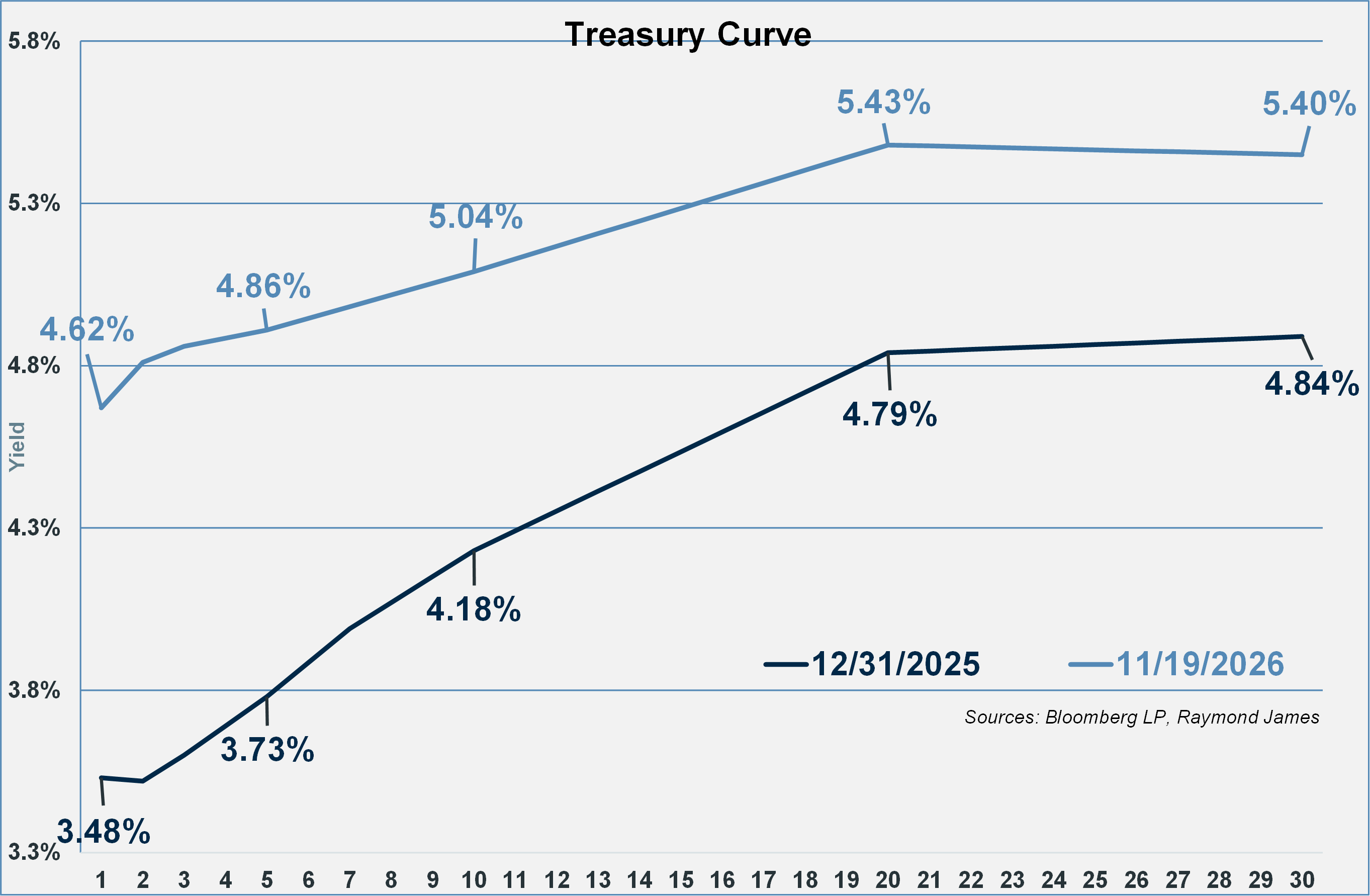
The importance of this shift becomes even clearer when viewed over a longer investment horizon. Following the financial crisis of 2008–2009, investors endured an extended period of historically low interest rates. For many years, generating meaningful income from high-quality fixed income securities was challenging. Investors seeking additional yield often faced difficult choices involving longer maturities, lower credit quality, or more complex investment structures.
Today's environment is substantially different. Higher Treasury yields, combined with the additional income potentially available from municipal and corporate bonds, provide investors with opportunities to establish meaningful cash flows using securities that may align with their risk tolerance, tax circumstances, and long-term objectives.
The question is no longer simply whether interest rates will rise another quarter or half percentage point. A more productive question is whether the yields currently available can help an investor accomplish their long-term financial goals.
The forces influencing interest rates are neither simple nor necessarily aligned. Economic weakness, geopolitical uncertainty, or equity market volatility can encourage investors to seek the relative safety of U.S. Treasuries. Increased demand pushes Treasury prices higher and yields lower. Yet the same geopolitical uncertainty can disrupt energy supplies, raise production costs, and fuel inflation, creating upward pressure on interest rates. The same event can produce opposing outcomes depending on which consequence investors perceive as the greater threat.
Inflation remains one of the most consequential influences. Despite progress made over time, elevated inflation has proven persistent, complicating the Federal Reserve's efforts to balance price stability with sustainable economic growth. A stronger than expected economy can reinforce inflation concerns, reduce the likelihood of monetary easing and potentially encourage tighter policy. Conversely, a weakening labor market or deteriorating economic outlook can increase expectations for lower policy rates and can support shorter-maturity Treasury prices.
The federal government's substantial borrowing needs require a steady stream of Treasury issuance. Investors must absorb that debt, and the yields required to attract sufficient demand can influence interest rates independently of Federal Reserve policy. Greater supply, all else equal, can put upward pressure on yields, particularly at longer maturities. However, strong demand from domestic and international investors can offset some of that pressure. Treasury yields ultimately reflect the interaction of inflation expectations, economic growth, monetary policy, term premiums, and the market's willingness to finance government borrowing.
These competing influences help explain why interest rates can move sharply in either direction, sometimes without a meaningful change in the underlying long term economic outlook. It also explains why forecasting the precise peak in interest rates is so difficult. Predicting the direction of rates requires anticipating not only future events, but also how investors will interpret those events and which economic concern will dominate at any moment.
The fixed income market will undoubtedly continue to experience volatility. Inflation will remain a concern, economic growth will surprise in both directions, geopolitical events will influence investor sentiment, and Treasury borrowing requirements will continue to shape the supply and demand equation. The dominant market narrative may change from one day to the next. What should not change so frequently is an investor's long-term financial plan.
We cannot know whether today's yields represent the absolute peak of this interest rate cycle. Rates may move higher, and investors who purchase bonds today could see their market values decline further. Equally important, rates may move lower, leaving those who waited to face less attractive opportunities to establish long-term income.
The substantial rise in yields from the beginning of the year is not merely a story about bond market volatility. It is also a story about opportunity. The market is offering investors the ability to secure levels of income that were far more difficult to obtain during much of the preceding decade and beyond. Perhaps the most important question investors can ask is not, "Have interest rates peaked?" but rather, "Can the interest rates available today help me achieve my long-term financial goals?"
The first question requires a forecast that nobody can reliably provide. The second requires a financial plan, an understanding of investment objectives, and the discipline to recognize opportunity when it presents itself. Perhaps the greatest risk is taken by investors who put off buying bonds because they think interest rates have not yet peaked. It is allowing the pursuit of that elusive peak to prevent an investor from securing an attractive long-term outcome.
The author of this material is a Trader in the Fixed Income Department of Raymond James & Associates (RJA), and is not an Analyst. Any opinions expressed may differ from opinions expressed by other departments of RJA, including our Equity Research Department, and are subject to change without notice. The data and information contained herein was obtained from sources considered to be reliable, but RJA does not guarantee its accuracy and/or completeness. Neither the information nor any opinions expressed constitute a solicitation for the purchase or sale of any security referred to herein. This material may include analysis of sectors, securities and/or derivatives that RJA may have positions, long or short, held proprietarily. RJA or its affiliates may execute transactions which may not be consistent with the report’s conclusions. RJA may also have performed investment banking services for the issuers of such securities. Investors should discuss the risks inherent in bonds with their Raymond James Financial Advisor. Risks include, but are not limited to, changes in interest rates, liquidity, credit quality, volatility, and duration. Past performance is no assurance of future results.
Investment products are: not deposits, not FDIC/NCUA insured, not insured by any government agency, not bank guaranteed, subject to risk and may lose value.
To learn more about the risks and rewards of investing in fixed income, access the Financial Industry Regulatory Authority’s website at finra.org/investors/learn-to-invest/types-investments/bonds and the Municipal Securities Rulemaking Board’s (MSRB) Electronic Municipal Market Access System (EMMA) at emma.msrb.org.